TL;DR
TL;DR
-
Major consumer wearable brands are entering brain health. Oura just launched a 45,000-person study, but without EEG, they can only infer cognitive patterns from body signals. Inference has its limits
-
Measuring brain health requires reading the brain directly, via EEG, the same technology neuroscientists have used in labs for decades
-
Since 2014, Muse has been supporting brain studies. Independent researchers at major institutions like Harvard, MIT and Mayo Clinic use Muse hardware to collect brain data, 200+ peer-reviewed studies published
-
Muse also brings that same science to everyday users: better sleep, sharper focus, lower stress, all driven by real brain measurement
-
Brain health is the next frontier in wellness. From dementia prevention to remote patient monitoring, the science is accelerating. The foundation was already being built.
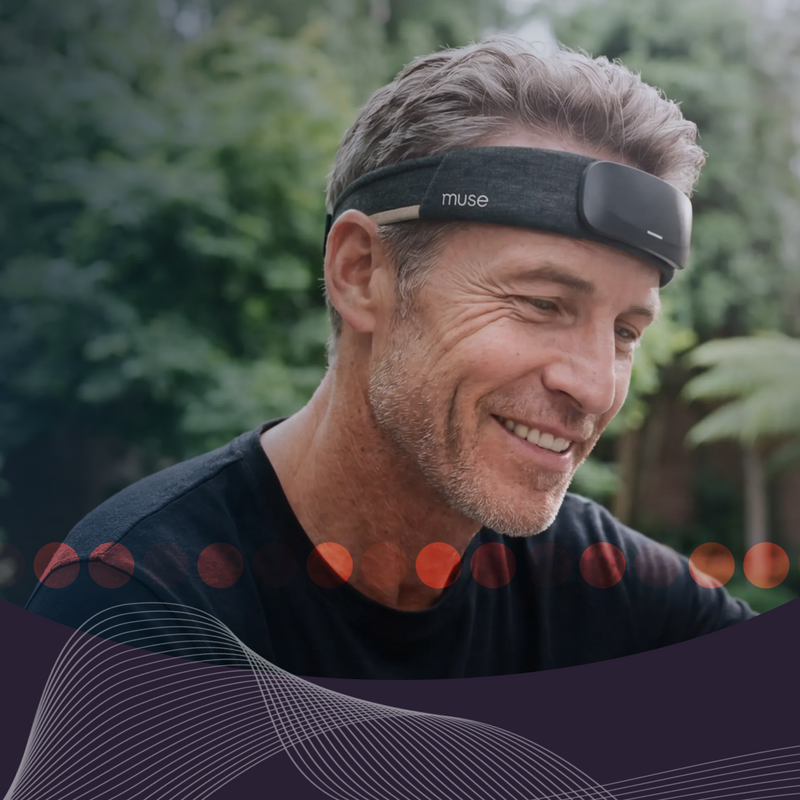
For years, brain health technology was considered niche. EEG, the gold standard for measuring brain activity, lived in neuroscience departments and sleep clinics, not something the average person thought they could access at home. Muse was built to change that. Since 2014, we've been putting clinical-grade EEG into a brain health wearable anyone can wear. The barrier was never the science, but awareness.
That awareness is now catching up fast. Major names in consumer health tracking are starting to turn their attention toward the brain, and brain health is officially on the mainstream agenda.
We think that's generally a good thing. But before the space gets crowded, there's something worth understanding: the only way to truly understand the brain is by measuring the brain directly.
Why are wearable brands investing in brain health now?
The numbers tell the story. The Global Wellness Institute valued the global wellness industry at $6.8 trillion in 2024, with projections placing it at around $9.8 trillion by 2029, largely driven by consumer interest in preventative health and mental wellness. Cognitive performance, once a priority reserved for high-performing athletes and executives, is now a mainstream concern. People want to know how their brain is aging, how well it's recovering overnight, and whether what they're doing day to day is actually making a difference.
Marie Claire UK named brain health one of the top wellness trends of 2026, noting that cognitive fitness is being "powerfully redefined as a priority for every stage of life." The supplement industry is responding with nootropics. The fitness world is responding with nervous system regulation and breathwork. And now, consumer wearable giants are responding too.
Oura, one of the biggest names in consumer health tracking, recently announced a 45,000-person brain health study with Cambridge Cognition, pairing cognitive assessments with ring data like heart rate, temperature, and movement. It's the clearest signal yet that the category is reaching an inflection point. When a company with millions of users and significant institutional backing turns its attention toward cognition, it signals something the neuroscience community has known for years: the brain is the next frontier in consumer health.
What does it actually take to measure brain health?
Oura's brain health study is a meaningful step. But it's worth being clear about what the ring actually measures: heart rate, skin temperature, and movement. From those signals, it infers patterns that may relate to cognitive function. That's a reasonable scientific approach, and a dataset of 45,000 participants will likely produce interesting population-level insights.
But inference is not the same as direct measurement. The gold standard for measuring brain activity is EEG, electroencephalography. It's the same technology neurologists use in sleep labs to score sleep stages, the same signal researchers use to study cognition, stress, and neurological conditions in academic settings. EEG captures the brain's electrical activity directly, in real time, at the millisecond level.
A ring or wrist-worn device isn't built to do this. Its sensors are positioned and designed to read cardiovascular and movement signals, not neural ones. To read the brain directly, you need a sensor in contact with the head.
|
EEG Headband (Muse) |
Body-worn ring/wrist device |
|
|
What it measures |
Brain's electrical activity directly |
Heart rate, movement, skin temperature |
|
How it works |
Reads brainwaves in real time |
Infers brain states from body signals |
|
Sleep staging |
Directly reads brain activity during each sleep stage |
Estimates sleep stages from motion and HR |
|
Cognitive training |
Real-time neurofeedback based on brain state |
Not possible without direct brain signal |
|
Used in brain-related academic research |
Varies |
Compare EEG brain training devices
How has consumer brain health research evolved?
While brain health is only now entering the mainstream conversation, a small group of companies and researchers have been quietly building the science behind it for over a decade. Consumer EEG, the ability to read brainwaves outside a clinical setting, has been an active area of development since the early 2010s. Companies like Emotiv and NeuroSky helped establish that consumer-grade EEG was technically feasible, primarily targeting researchers and developers looking for accessible brain-computer interface tools.
Muse took a different path. When InteraXon launched Muse in 2014, the goal wasn't to build a research instrument. It was to make brain health genuinely accessible to everyday people, without gel electrodes, without a technician in the room, and without a clinical setting. The idea that someone could read their own brainwaves at home, in real time, and use that data to improve their sleep, focus, and stress was largely dismissed by the industry.
We built it anyway.
What followed was a decade of compounding research. Today, Muse has accumulated over 1 billion minutes of at-home EEG data, the world's largest dataset of its kind, across 16.8 million EEG sessions and 500,000+ devices worldwide. Independent researchers at Harvard, MIT, Mayo Clinic, and NASA have chosen Muse as their brain measurement tool, producing 200+ peer-reviewed publications in the process. When academics need clinical-grade brain data outside a lab, Muse is what they reach for.
In 2022, we went further. Muse S Athena became the first consumer wearable to combine EEG with fNIRS (functional near-infrared spectroscopy) a second brain-sensing technology that measures blood oxygenation in the prefrontal cortex. Where EEG tells you how your brain is firing, fNIRS tells you how hard it's working and how well it's fueling itself under cognitive load. Together, they deliver a complete picture of brain performance that no single sensor can match.
That combination unlocked something new: Mental Strength Training, an eyes-open, active cognitive training mode where realtime fNIRS feedback powers a brain workout experience.
From day one, Muse has been building toward brain health, one sensor at a time. Read more about the science behind EEG + fNIRS.

What can a brain health wearable actually do for you?
Tracking the brain is one thing. Doing something useful with that data is another. This is where direct brain measurement earns its keep. EEG and fNIRS tell you what's happening right now, at the sub-second level, which is what makes realtime intervention possible.
Muse works across three pillars: sleep, focus, and stress.
How does Muse improve your sleep?
Most sleep wearables tell you how long you slept and estimate what stage you were in based on how much you moved and how your heart rate changed. Muse reads your brainwaves directly all night, the same signal sleep clinicians use in a polysomnography lab, validated at 88-96% per-stage agreement with PSG, the clinical gold standard.
With accurate real-time tracking, Muse is able to actively improve your sleep:
-
Sleep Assist plays responsive soundscapes that shift based on your brain activity as you drift off, easing your nervous system toward sleep 55% faster.
-
Deep Sleep Boost delivers phase-timed audio stimulation during slow-wave sleep, resulting in 76% more organized slow waves in beta testing.
[Additional internal Deep Sleep Boost metrics available here] -
Smart Wakeup reads your brain state in real time to find the optimal wake window each morning, something that simply cannot be done without a direct brain signal
A 2021 study co-led by Interaxon and Western University found that Muse S EEG sleep support improved Pittsburgh Sleep Quality Index scores by 20% compared to a control group.
Muse S Athena vs other sleep trackers
How does Muse improve your focus?
Muse S Athena's fNIRS sensor measures blood oxygenation in the prefrontal cortex in real time, reflecting how hard your brain is working and how well it's sustaining cognitive effort.
-
Mental Strength Training uses that signal to power an eyes-open neurofeedback experience, training focus and mental endurance by helping the brain sustain attention and push through cognitive load, rather than tracking it after the fact
-
Mind biofeedback sessions use real-time EEG to train sustained attention in an eyes-closed state, giving live audio feedback as your mind shifts between focus and wandering
-
Alpha Peak, measured via EEG, tracks your brain's dominant rhythm over time as a long-term marker of cognitive performance, often described as the HRV of the brain.
How does Muse help relieve stress?
During mind, heart, and body sessions, Muse’s EEG sensors read your brain's electrical activity in real time, providing neurofeedback that trains the brain to shift from active, high-beta stressed states toward calmer, alpha-dominant patterns. Over time, that builds genuine mental resilience at the neurological level, not just a momentary feeling of relaxation.
Brain Recharge Score tracks how well your brain recovers after stress or exertion, based on alpha power measured during your sessions. Enso the AI Brain Coach personalizes your training based on your brain data over time.
The research backs it up. A pilot with 40 healthcare workers found significant stress reductions (p < .001), improvements in resilience and cognitive performance, and 91.9% of participants felt more relaxed post-session, and a 54% reduction in burnout over 26 weeks.
Why do researchers choose Muse to study the brain?
One of the strongest signals that a piece of technology is genuinely measuring what it claims to measure is when independent scientists choose it for their own research. Muse has become one of the most widely used consumer EEG devices in peer-reviewed neuroscience because the signal holds up under academic scrutiny.
Here's a sample of what researchers have found when they put Muse to work:
|
Study |
What they used Muse for |
Key finding |
Source |
|
IEEE/EMBS Conference on Neural Engineering, 2023 |
Automated sleep staging at home |
Reliable classification of sleep stages outside a lab at scale |
|
|
Imaging Neuroscience, 2024 |
Predicting brain age from overnight EEG |
Muse EEG during sleep can predict chronological age, a potential long-term brain health biomarker |
|
|
Frontiers in Neuroscience, 2021 |
Measuring cognitive fatigue across 1,000 participants |
Significant correlations between Muse EEG markers and self-reported mental exhaustion, collected in under 7 minutes per person |
|
|
Journal of Surgical Research, 2024 |
Detecting cognitive load during clinical tasks |
Muse EEG reliably detected cognitive load variations in real-time healthcare monitoring |
|
|
IEEE Journal of Biomedical and Health Informatics, 2019 |
Stress classification from EEG |
92% binary accuracy classifying perceived stress levels from 28 participants |
|
|
Computational Intelligence and Neuroscience, 2022 |
Stress classification using LSTM model |
93% accuracy classifying stress levels from 35 volunteers |

Where is brain health technology headed next?
We've spent over a decade building the foundation. What excites us is what that foundation is now making possible.
EEG sleep monitoring as brain health indicator
Beyond recovery, sleep is when the brain consolidates memory, clears metabolic waste through the glymphatic system, and runs what amounts to a nightly maintenance cycle.
We already know sleep itself can carry early warning signs: REM sleep behavior disorder, a condition where the body fails to stay still during REM sleep, is a well-established precursor to certain neurodegenerative conditions, sometimes appearing years before a formal diagnosis. That link is part of what's driving a broader research question: could subtler overnight EEG patterns, beyond diagnosable sleep disorders, also flag neurological change before symptoms appear?
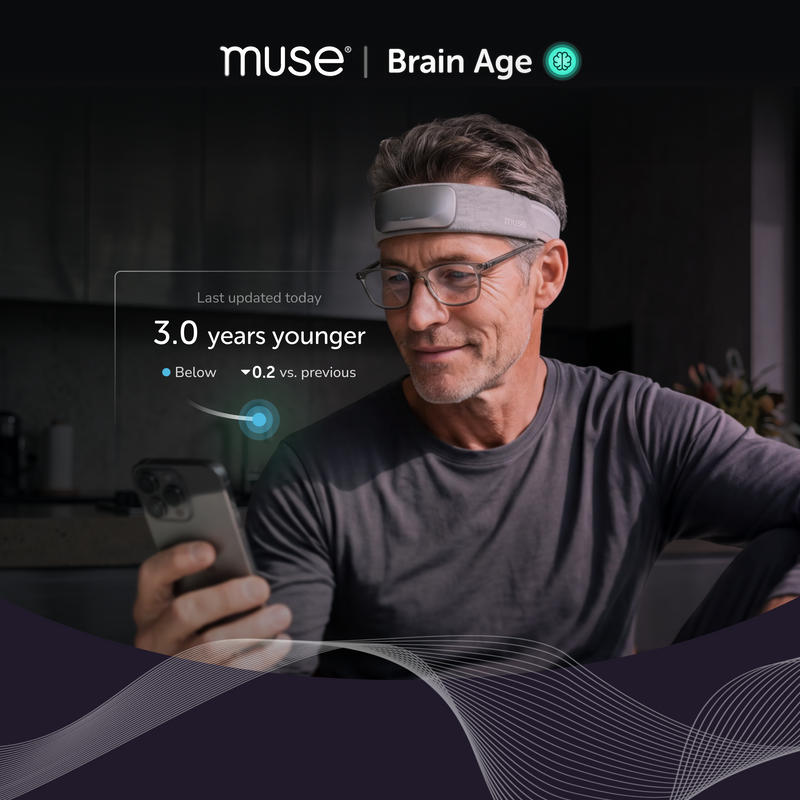
Muse's own research team has shown that at-home EEG recordings during sleep can predict brain age, using a dataset of over 5,200 participants. It's early-stage work, and the field is still establishing how reliably at-home sleep data can flag risk before symptoms appear, but it points toward overnight EEG becoming an increasingly important tool in long-term brain health monitoring.
Dementia prevention and early detection
Alzheimer's disease and other forms of dementia are increasingly understood as conditions that begin changing the brain years, sometimes decades, before a clinical diagnosis.
In the broader research literature, Peak Alpha Frequency, a brainwave marker Muse already tracks (Alpha Peak), has been repeatedly linked to cognitive decline and is being studied as a potential indicator of cognitive aging.
Combined with fNIRS measures of prefrontal blood oxygenation, the picture becomes richer: a 2025 study in Frontiers in Aging Neuroscience found that resting-state prefrontal connectivity measured via fNIRS could help distinguish subjective cognitive decline from mild cognitive impairment.
Translating findings like these into reliable at-home monitoring is still early-stage work, but it points toward a future where consumer brain wearables could play a meaningful role in early detection research.
Longitudinal brain monitoring and research applications
Clinical sleep studies typically capture a single night of data. A consumer EEG device worn over weeks or months can generate a much larger volume of longitudinal brain data than episodic lab visits allow. This is part of a broader shift researchers are exploring: moving from one-off snapshots toward continuous, real-world brain monitoring over time.
Consumer EEG devices, while not diagnostic tools, are increasingly being used as a research instrument in this kind of longitudinal work, generating the kind of large-scale, real-world datasets that are difficult to collect in a lab.
New stimulation frontiers
Muse already delivers phase-timed acoustic stimulation during deep sleep via Deep Sleep Boost, timed to the brain's own slow wave rhythms via real-time EEG.
The next horizon includes other stimulation modalities. Light stimulation, or photobiomodulation, is an area of active research, with early studies suggesting that specific wavelengths of near-infrared light applied to the brain may influence sleep architecture, reduce neuroinflammation, and support cognitive recovery. Companies like Vielight are building in this space, with ongoing clinical trials exploring its effects on brain function and cognition in older adults. We're watching it closely.
Brain-AI convergence
The intersection of large EEG datasets and modern AI is unlocking pattern recognition that wasn't possible even five years ago. Muse's foundational brain model, trained on over 80,000 curated sessions from the world's largest EEG database, is the infrastructure behind features like personalized cognitive performance scoring and Enso, Muse's AI coach, which adapts training based on your brain's data over time.
As these models mature, researchers see real potential in predictive brain health insights, patterns that could one day help flag meaningful changes before they become noticeable day to day. Muse is not a diagnostic device, but the dataset and AI infrastructure it's built make it a meaningful part of that research direction.
The brain health race is just getting started
A decade ago, almost no one outside a research lab was thinking seriously about measuring the brain at home. Today, some of the biggest names in consumer health are starting to, and we think that's a good thing.
As more people pay attention to brain health, it's worth remembering that inferring brain states from heart rate and movement is different from reading the brain directly. We've spent over ten years building toward real brain measurement at home: the science, the dataset, and the hardware to back it up. The brain health race is on, and we've been part of it since 2014.
Experience the difference direct brain measurement makes. Shop Muse S Athena.
FAQs
Q: What is fNIRS, and how does it complement EEG?
A: fNIRS (functional near-infrared spectroscopy) measures blood oxygenation in the prefrontal cortex, showing how hard the brain is working under cognitive load. Where EEG captures how the brain is firing, fNIRS captures how well it is fueling itself, and together they provide a more complete picture of brain performance.
Q: How accurate is Muse for sleep tracking compared to clinical tools?
A: Muse's EEG-based sleep staging has been validated at 88 to 96% per-stage agreement with polysomnography (PSG), the clinical gold standard for sleep measurement.
Q: What does Muse S Athena's Mental Strength Training actually do?
A: It uses real-time fNIRS feedback to power an eyes-open neurofeedback experience, training the brain to sustain attention and push through cognitive load rather than simply tracking performance after the fact.
Q: Can brain wearables help with stress, or just track it?
A: Muse's EEG sensors provide real-time neurofeedback during sessions, training the brain to shift from high-beta stressed states toward calmer, alpha-dominant patterns. A 90-day pilot with 40 healthcare workers found significant stress reductions and a 54% reduction in burnout over 26 weeks.
Q: Can a wearable actually measure brain activity?
A: Yes. EEG, the same technology used in clinical sleep labs, can be built into a consumer headband. Muse and it’s Muse S Athena & Muse 2 headbands have done this since 2014, capturing brainwave activity at the millisecond level without gel electrodes or a clinical setting. Most wrist and ring wearables don't include EEG sensors, so they can't measure brain activity directly.
Q: What does EEG measure that a ring or wrist device can't?
A: EEG measures the brain's electrical activity directly through sensors on the head. A ring or wrist device measures heart rate, movement, and skin temperature, none of which originate in the brain. EEG can detect sleep stages, focus, and stress as they happen in the brain itself, not estimated from secondary body signals.
Q: How does Muse improve deep sleep?
A: Muse's Deep Sleep Boost reads brain activity in real time and delivers precisely timed acoustic stimulation during the brain's natural slow-wave upstate. In beta testing, this produced 24% longer slow-wave trains, 42% more slow-wave trains per minute, and 76% more organized slow waves. This requires direct brain measurement and can't be replicated by a device that only tracks heart rate and movement.
Q: What is the future of brain health technology?
A: Researchers are exploring overnight EEG as an early indicator of long-term brain health, EEG combined with fNIRS for deeper insight into cognitive aging, AI applied to large-scale brain datasets for personalized insights, and new intervention methods like light-based stimulation. Consumer EEG devices are increasingly used as research tools in this work.
Q: Are there chemical-free ways to support cognitive performance?
A: Yes. Neurofeedback, training the brain using real-time EEG feedback, is a non-pharmaceutical approach with decades of clinical research behind it. Muse applies this through eyes-open and eyes-closed sessions that use your own brain data to guide training, without supplements or stimulants.
Q: How can I get a clearer picture of my mental clarity day to day?
A: Mental clarity is difficult to self-assess accurately. EEG-based tools like Muse S Athena track brain markers such as Alpha Peak Frequency over time, giving a consistent, measurable signal for cognitive state rather than relying on subjective impressions alone.
Q: What's the difference between meditation apps and EEG-based brain training?
A: Meditation apps guide you through a session using audio or visual cues, without measuring what your brain is actually doing. EEG-based brain training, like Muse's biofeedback sessions, reads your real-time brain activity and adjusts feedback accordingly, so the experience responds to your actual mental state, not a fixed script.